Re:Do vs Mainstream Fitness Apps
This is not a “better or worse” comparison. It is a philosophy difference. Mainstream apps often optimize for engagement systems. Re:Do optimizes for planning, execution, and review.
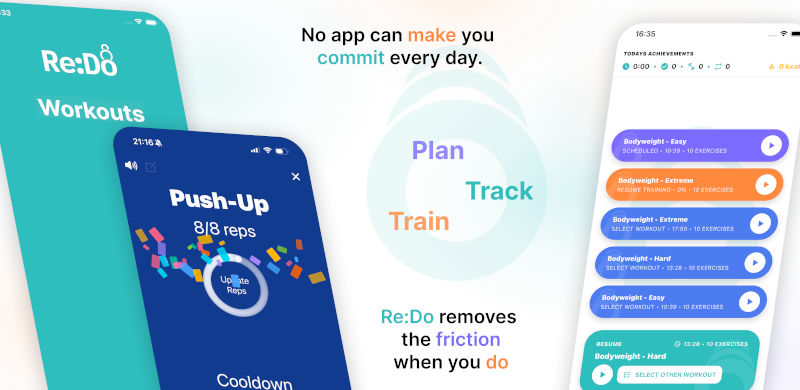
Plan your own training in Re:Do Workouts.
Create the workout in your own words, run it step by step with timers and notes, schedule it when it fits, and log what actually happened.
Mainstream fitness app pattern
- Content-heavy feeds and coaching systems
- Motivation loops and streak pressure
- Big promise framing
- More time in app, not always more training done
When mainstream apps are a great fit
Mainstream apps can be excellent if you want a guided beginner plan, coaching content, or a social/community layer. If you feel lost without direction, a prescriptive app can remove decision fatigue early on.
Re:Do pattern
- Plan your own workouts
- Play workouts with low friction
- Track completed work clearly
- Stay focused on sessions, not app theater
Different job, different design
Re:Do is built for the “I already train” moment: you have a plan (or you can make one), but you want a cleaner workflow. The player keeps execution readable. The editor keeps your routines adjustable. The log keeps a usable record.
How to decide in 30 seconds
- If you want a coach inside the app → mainstream tools will often fit
- If you want a tool to run your plan → Re:Do will often fit
- If you hate pressure mechanics → start with the philosophy pages
Who should choose Re:Do
People who already know what they train and want less noise. If you prefer calm tooling over motivational ecosystems, Re:Do will likely fit better.
FAQ
Is Re:Do anti-coaching?
No. It is pro-tooling. Coaching can be valuable, but not everyone wants it inside the app.
Is this a niche app?
Yes, intentionally. It serves self-directed training behavior.
Does Re:Do replace a coach?
No. It replaces friction in your workflow. Coaches can still be valuable; Re:Do is a tool for execution and tracking.