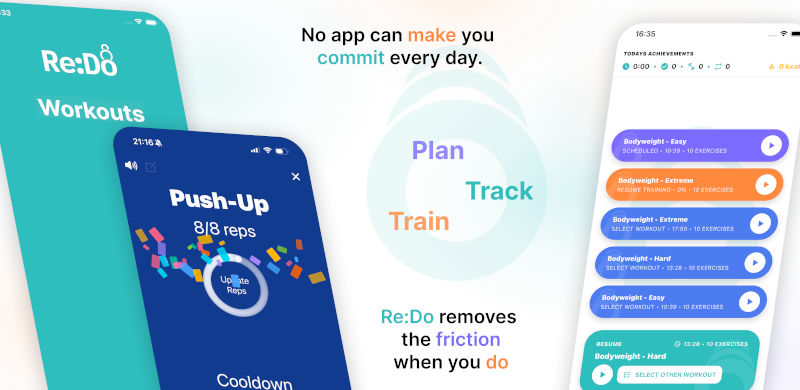
Track Bodyweight Workouts App
Good tracking is not about endless charts. It is about seeing what was done, noticing patterns, and deciding what to do next. Re:Do keeps tracking focused on actual training decisions.
Plan your own training in Re:Do Workouts.
Create the workout in your own words, run it step by step with timers and notes, schedule it when it fits, and log what actually happened.
Useful tracking for real training
- See completed workouts clearly
- Use history to keep consistency
- Focus on your own progression patterns
- Review logs without dashboard overload
Why bodyweight tracking can be tricky
Bodyweight training often mixes reps, hold times, and different progression stages. Clean notes and repeatable session structure matter more than generic performance scores.
Tracking also needs to reflect reality: sometimes you do partial volume, skip sets, or change progressions. A good log should record what happened without turning the session into admin work.
What to log (simple and effective)
- Reps or hold time for key movements
- Variations/progression level (e.g. assisted, strict, tempo)
- Notes on form or constraints (sleep, elbows, time)
- Completion notes when you cut a session short
Example
You repeat a pull progression workout across six weeks. The key signal is whether volume and quality are moving in the right direction, not whether an external score goes up daily.
How to use this page in Re:Do
Treat Track Bodyweight Workouts App as a focused setup guide, not a separate system to maintain. Use it when the equipment or training style is fixed but the routine needs structure: keep exercises, notes, progression, and logged sessions in one place.
The useful version is usually small at first: one workout, one schedule or timer rule if needed, and enough notes to make the next session obvious. After a few logged sessions, refine the plan clearly from what you actually did instead of guessing up front.
FAQ
Is this only for bodyweight athletes?
No. The same tracking model works for mixed training too.
Do I need to log everything perfectly?
No. Consistent, practical logs are usually enough to improve decisions.
What if I train skills and strength together?
That is common in bodyweight training. Mixing timed blocks and reps in one routine helps keep the session runnable.