Workout App Export JSON
If you search for workout app export json, you usually care about portability: you want your plan and history to survive app changes. This guide covers what to look for when you want to workout app export routine data.
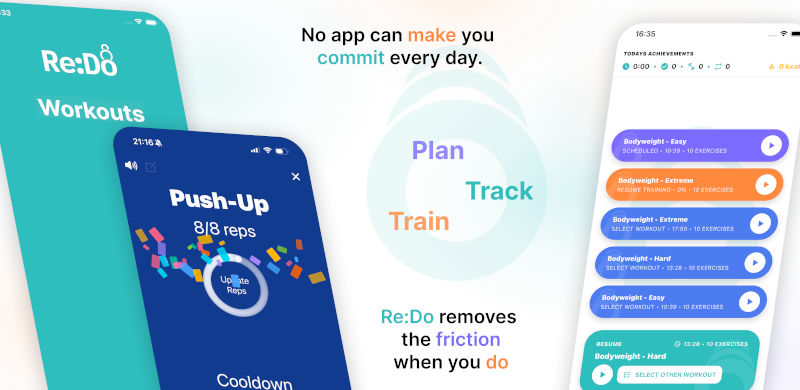
Plan your own training in Re:Do Workouts.
Create the workout in your own words, run it step by step with timers and notes, schedule it when it fits, and log what actually happened.
This is not only a “power user” concern. Even if you never touch the export file, a clear export story is a signal that the product respects data ownership and long-term trust.
What people mean by “JSON export”
- A portable file format you can store yourself
- A documented workout json format (not an opaque blob)
- A stable way to re-import or migrate later
What should be exportable?
“Export routine” is often shorthand for multiple things. If you are evaluating any workout app, check whether you can export:
- Routines/workouts (the plan: exercise order, sets, reps, time blocks)
- Exercise library (the names + notes you rely on)
- Training log/history (what you actually completed)
What makes a good workout JSON format
A good format is boring in the best way: consistent, versioned, and easy to interpret later. The goal is portability without guesswork.
- Versioned schema so old exports don't break
- Stable IDs so exercises and logs stay connected
- Human-legible fields (not just compressed blobs)
- Clear unit semantics (kg/lb, seconds, rounds)
Example structure (illustrative)
You don't need this exact shape. But you want something that looks like structured data, not a mystery string:
{
  "schemaVersion": 1,
  "workouts": [
    {
      "name": "A Day",
      "blocks": [
        { "type": "setsReps", "exercise": "Pull-ups", "sets": 5, "reps": 5 },
        { "type": "timer", "label": "Rest", "seconds": 120 }
      ]
    }
  ]
}
Open formats and APIs
Some searches are specifically about an open workout format app or a workout tracker with api. Others are about being able to run the whole thing yourself, like a self hosted workout tracker alternative. These are valid requirements if you have strong data ownership needs.
If you truly need an API, be clear about the use case: sync to a spreadsheet, build dashboards, connect to your own coaching tooling, or just keep a long-term archive. “Has API” can mean anything from a private endpoint to a well-documented public interface.
Portable routines
If you want portable workout routines, look for products that make export and migration explicit: documented formats, predictable structures, and a commitment to compatibility.
- Can you export without a paid tier?
- Can you export from both iOS and Android?
- Can you restore from export on a new device?
How this connects to privacy
Export is also a privacy signal. If you care about local-first behavior, look for clear statements about where data is stored and how backups work. Start here: Privacy Policy.
FAQ
Is JSON export the same as an open format?
Not necessarily. JSON is a container. “Open format” is about documentation, stability, and compatibility over time.
Do I need an API?
Only if you want integrations. Many people just want a file export so their routine and history are portable.
What if I only want to export routines, not logs?
That can be enough if you mainly care about planning portability. If you care about progress review, exportable logs matter too.
What should I store from an export?
Keep it like any other important file: in your normal backup flow (cloud drive, encrypted archive, external drive).