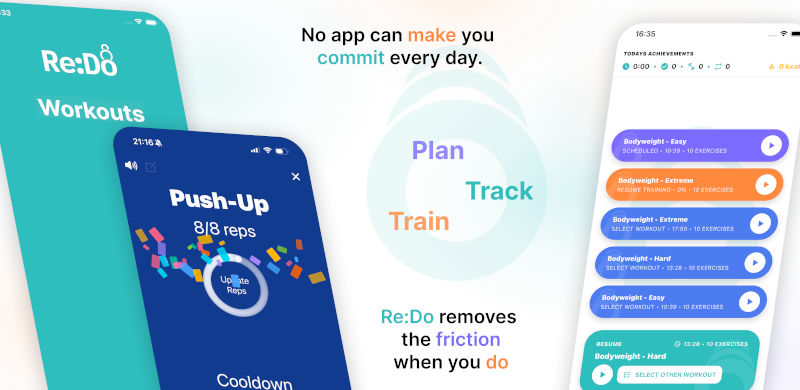
Re:Do Workouts banner for the rehabilitation quick start program

Rehabilitation (Low-Impact) Quick Start Program

This is a gentle rehabilitation exercise program you can import into Re:Do as a Starter Program. It focuses on controlled ranges of motion and simple activation drills. For the full directory, see Quick Start Workout Programs.

This page is not medical advice. If you have an injury, recent surgery, or worsening symptoms, follow your clinician’s plan and stop if movements are painful.

At a glance

This is a low-impact rehab routine intended to stay pain-free and repeatable. Progress is usually small: more comfort, smoother range, and slightly more total volume over time.

How to install (import) in Re:Do

In the app, go to: Routines → Programs → Starter Program → Import.

Workouts in this starter program

The right difficulty is the one you can do with steady breathing, clean control, and no pain during or after.

Exercises (and how to vary them)

Ankle Pumps
While seated or lying down, alternate pointing your toes away and then pulling them back toward you in a slow, controlled rhythm.
Variations: smaller range (easier), add ankle circles (slightly harder), longer sets (harder endurance).

Heel Slides
Lie on your back with legs straight. Slide one heel toward your hips to bend the knee, then slide it back to straight. Alternate sides.
Variations: use a towel under the heel (easier), add a short pause at the end range (harder), shorten range if uncomfortable.

Quad Sets
Sit or lie with the leg straight. Tighten the front thigh muscle by pressing the back of the knee gently down, hold briefly, then relax.
Variations: longer holds (harder), use a towel under the knee for feedback, progress only if pain-free.

Glute Squeezes
While lying or seated, squeeze your glutes together, hold briefly, and release. Keep the movement small and controlled.
Variations: longer holds (harder), add more reps (harder), progress toward bridges if appropriate.

Pelvic Tilts
Lie on your back with knees bent. Gently flatten your lower back toward the floor by tilting your pelvis, then return to neutral.
Variations: smaller tilts (easier), add a longer exhale during the tilt (control), progress slowly to more range if comfortable.

Bridge (Low)
Lie on your back with knees bent. Lift your hips slightly off the floor, keeping ribs down, then lower with control.
Variations: micro-bridges (easier), longer holds at the top (harder), progress to a higher bridge only if pain-free.

Wall Push-Up
Stand facing a wall, hands on the wall at chest height. Bend elbows to bring chest toward the wall, then press back to start.
Variations: stand closer to the wall (easier), stand farther (harder), progress to counter push-ups (harder).

Seated March
Sit tall in a chair. Alternately lift one knee a few centimeters, then the other, keeping the movement smooth and upright posture.
Variations: slower tempo (control), higher knee lift (harder), add a light band around feet (harder) if appropriate.

Shoulder Blade Squeezes
Sit or stand tall. Gently draw shoulder blades back and down as if pinching a pencil between them, hold briefly, then relax.
Variations: longer holds (harder), add a light band row pattern (harder), keep range small if shoulders are sensitive.

Neck Range of Motion
Slowly move your head through comfortable ranges: turn left/right, nod down/up, and tilt ear toward shoulder. Stop if painful.
Variations: smaller range (easier), slower reps with breath (control), skip any direction that aggravates symptoms.

Progression (when it gets too easy)

If symptoms increase after sessions (not just normal mild fatigue), reduce intensity or volume and consider getting clinical guidance.

FAQ

Is this a physical therapy program?
No. It is a low-impact starter pack of common gentle movements. Use it as a simple routine only if it fits your situation and stays pain-free.

How many days per week should I do it?
Many people do gentle rehab-style sessions 3–6 days/week, but the correct frequency depends on your condition and recovery.

Where do I import it in the app?
Use Routines → Programs → Starter Program → Import.

Can I edit the exercises?
Yes. Import, then adjust reps/time/range as needed. Keep changes conservative.

What should I do if something hurts?
Stop and reassess. Pain is a signal to reduce range/volume or get professional advice.

Where can I learn more about tracking sessions?
See workout tracking and training log editor.

Other topics