Workout Consistency & Training Rhythm
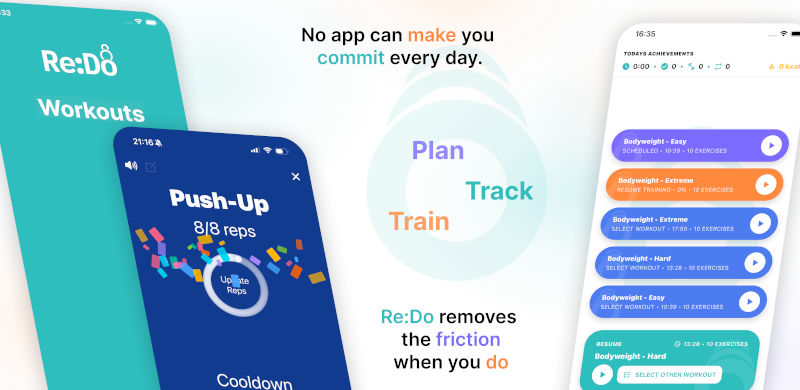
“Consistency” is usually framed as motivation. In practice it is a system problem: can you build a rhythm that survives travel, stress weeks, busy work periods, and the random stuff that happens? Re:Do focuses on making the system easy: plan sessions, run them, log what happened, then adjust the rhythm without drama.
Plan your own training in Re:Do Workouts.
Create the workout in your own words, run it step by step with timers and notes, schedule it when it fits, and log what actually happened.
Rhythm beats streaks
Streaks push you toward all-or-nothing thinking. Rhythm is simpler: keep a baseline alive and scale sessions up or down as life changes. This aligns with intent like no streak fitness app and fitness app without pressure: you want structure, not guilt mechanics.
- Choose a baseline (2–3 sessions/week is enough for many phases)
- Keep one “default session” you can do on low-energy days
- Review your log weekly, not emotionally after one missed day
A simple rhythm framework (that survives real life)
If you want consistency, keep the system small. This framework works for many people because it doesn't require perfect weeks:
- Baseline: the minimum sessions you aim to hit most weeks
- Default session: the short workout that keeps the baseline alive
- Stretch session: the longer workout you do when energy and time are available
- Review: a weekly check of logs and calendar patterns
The key is that the default session is not a consolation prize. It is the mechanism that keeps the rhythm stable.
Consistency needs a readable plan
A rhythm only works if the plan is easy to understand. That is why the workflow matters: routine building, scheduling patterns, and an execution view that keeps the next step obvious.
- Planning: Workout planning & routines
- Scheduling: Workout scheduling guide
- Execution: Workout player & timers
Consistency needs honest logs
You can’t adjust rhythm without a record. Re:Do supports clean logs without a coach wrapper: a training log view plus a gym-style log editor you can switch into during a session.
Two subtopics to build your rhythm
Where rhythm breaks (and what usually fixes it)
When a plan “fails”, it’s often not because you stopped caring. It’s because the week changed and the system couldn't adapt. These are common breakpoints and practical fixes:
- Time disappears: shorten the default session and lower the baseline temporarily
- Setup friction: simplify the routine and run it in the player view
- Logging is annoying: use the log editor mode so set-by-set entry is quick
- Scheduling mismatch: switch to flexible patterns (schedule once / every X days)
This is why a tool-first workflow matters: your plan and log should be easy to adjust without rebuilding everything.
Goals and optimization (optional, second layer)
If you like goals, keep them minimal and aligned with rhythm. If you like suggestions, use them as feedback from your history. Both should remain optional so the app stays useful even when you ignore them.
If you use a consistency goal, treat it as a baseline reminder, not as a scoreboard: Consistency goals.
FAQ
How many workouts per week do I need for consistency?
Enough that you can repeat it. Two or three sessions per week is often a better long-term baseline than chasing a perfect plan you can’t sustain.
What if I miss a week?
Restart with your smallest workable default session. The goal is to re-enter the rhythm, not to punish the gap.
Is consistency the same as motivation?
No. Motivation is variable. Rhythm is a design: simpler planning, clearer execution, and honest logs.
How do I know if my rhythm is improving?
Look at weeks, not days. If you want a simple view, use a calendar-style review: Workout consistency heatmap.