Workout Goals App
A goal should make training clearer, not heavier. If you want a workout goals app, the best kind of goals are the ones that match how you actually train: a movement you care about, a volume target, or a consistency target.
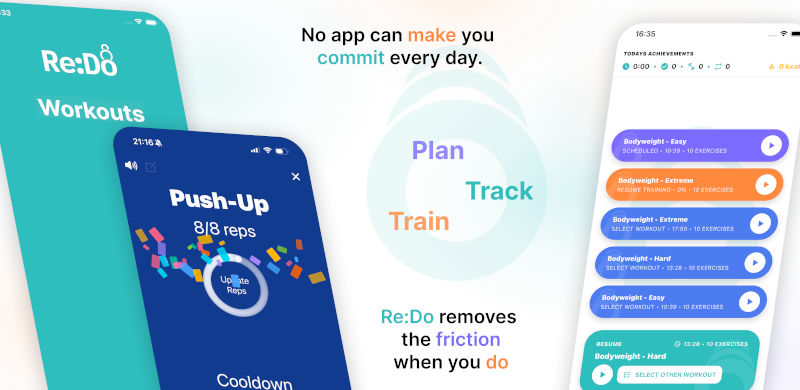
Plan your own training in Re:Do Workouts.
Create the workout in your own words, run it step by step with timers and notes, schedule it when it fits, and log what actually happened.
Three goal types that stay practical
- Exercise goals: improve a specific movement over time — Exercise goals
- Volume goals: build total reps/time over a period — Volume goals
- Consistency goals: complete workouts or active days over time — Consistency goals
Goals should be optional (not pressure)
Some people prefer a workout app without goals because goals can become pressure loops. A healthier approach is: goals are there when you want them, and invisible when you don’t.
How Re:Do approaches goals
Re:Do goals are designed to be readable and user-defined. The goal editor focuses on plain language and scope: exercises, volume, or consistency—so the goal fits the training you already do.
In the app, goals are not one giant “score”. They are specific targets you can pin, review, and adjust over time. You can keep it calm: one goal, one scope, one rolling window. That style tends to work best for experienced users who want a tool, not a coach voice.
How to set goals without breaking your training
- Keep goals small (one or two at a time)
- Use rolling periods (e.g. 4 weeks) instead of “all or nothing” deadlines
- Let goals support planning, not replace it
Exercise goals (movement-focused)
Exercise goals are for movements you care about. In Re:Do this typically looks like: pick an exercise, choose whether you track reps or time, and set a target that is realistic in your current phase.
- Absolute targets: “Hit 10 reps” or “Hold 60 seconds”
- Relative improvement: improve your best result by a percentage over a window
- Targets vs actuals: goals should reflect what happened, not what the app wanted
Volume goals (accumulation without drama)
Volume goals are a good match when you do a lot of the same category: pull work, conditioning minutes, or a specific accessory rotation. A volume goal helps you accumulate intentionally without turning training into a spreadsheet.
- Total reps or total time across a rolling period
- Works well with “default sessions” that keep the week moving
- Pairs naturally with a clean log editor when you track set by set
Consistency goals (track reality, not streaks)
Consistency goals are the most common, and the easiest to ruin with pressure mechanics. A healthier version is not “never miss”; it is “keep the rhythm alive”. That matches the intent behind searches like no streak fitness app and fitness app without pressure: you want structure without guilt.
- Workouts per week (or active days) across a rolling window
- Useful when your schedule is irregular but you still want a baseline
- Best when goals are optional and quiet in the UI
Notifications (optional)
In Re:Do, goal notifications are optional. You can choose to be notified when a goal is at risk (for example: you are behind on the rolling window) or when you reached it. The intent is gentle support, not engagement tricks.
FAQ
Do goals replace a program?
No. Goals are a layer on top of your plan. Planning still matters: the workouts you run create the result.
What if I hate gamification?
Goals don’t need rewards or streak pressure. The point is clarity, not engagement mechanics.
What if I want no goals at all?
That’s valid. A tool-first app should still be usable without goals.
Should I use exercise goals or consistency goals?
If you are rebuilding rhythm, start with consistency. If you already train consistently and want sharper direction,
use one exercise goal for something you actually repeat.
What makes a goal “good”?
A good goal is small enough that it improves the next workout decision. If it adds anxiety or admin work, it’s too big.